Incremental (mini-batch) EM#
When data arrives in a stream, or is too large to sweep each iteration,
IncrementalEMFitter updates the model from mini-batches, following the
online EM framework of Cappe2009. Each step computes the
batch expectation parameters \(\hat\eta\), then blends them into a running
estimate \(\eta_t\) through an \(\eta\)-update rule before the M-step. The
choice of rule controls the bias/variance and the forgetting behaviour of the
online estimate — including Robbins–Monro step sizes
(RobbinsMonro1951).
import jax
jax.config.update("jax_enable_x64", True)
import jax.numpy as jnp
import numpy as np

from normix import (
    NormalInverseGaussian,
    IdentityUpdate, RobbinsMonroUpdate, SampleWeightedUpdate,
    EWMAUpdate, AffineUpdate, Shrinkage, eta0_from_model,
)
from normix.fitting.em import IncrementalEMFitter
from normix.utils.plotting import set_theme

set_theme()
np.set_printoptions(precision=4, suppress=True)
Setup#
true = NormalInverseGaussian.from_classical(
    mu=jnp.array([0.0, 0.0]),
    gamma=jnp.array([0.4, -0.3]),
    sigma=jnp.array([[1.0, 0.3], [0.3, 1.0]]),
    mu_ig=1.0, lam=1.5)
X = true.rvs(8_000, seed=0)
init = NormalInverseGaussian.default_init(X)
key = jax.random.PRNGKey(0)
N_STEPS = 30
The six \(\eta\)-update rules#
A rule maps the previous estimate \(\eta_{t-1}\) and the batch estimate \(\hat\eta\) to the new \(\eta_t\). normix ships six:
Rule |
Update \(\eta_t\) |
|---|---|
|
\(\hat\eta\) (no memory) |
|
step-size \(\propto 1/(t + \tau_0)\) |
|
weight by cumulative sample count |
|
exponential moving average, weight \(w\) |
|
\(a + b\,\eta_{t-1} + c\,\hat\eta\) |
|
wrap a base rule, shrink toward \(\eta_0\) |
rules = {
    "Identity": IdentityUpdate(),
    "RobbinsMonro": RobbinsMonroUpdate(tau0=10.0),
    "SampleWeighted": SampleWeightedUpdate(),
    "EWMA(0.1)": EWMAUpdate(w=0.1),
    "Affine(½,½)": AffineUpdate(b=0.5, c=0.5),
    "Shrinkage": Shrinkage(IdentityUpdate(), eta0_from_model(init), tau=0.3),
}

target = float(true.marginal_log_likelihood(X))
print(f"target mean log-likelihood (true model): {target:.4f}\n")

finals = {}
for name, rule in rules.items():
    fitter = IncrementalEMFitter(
        batch_size=512, max_steps=N_STEPS, eta_update=rule,
        e_step_backend="cpu", m_step_backend="cpu")
    res = fitter.fit(init, X, key=key)
    finals[name] = float(res.model.marginal_log_likelihood(X))
    print(f"{name:16s} final mean log-lik = {finals[name]:.4f}")
target mean log-likelihood (true model): -2.7684
Identity         final mean log-lik = -2.7714
RobbinsMonro     final mean log-lik = -2.7840
SampleWeighted   final mean log-lik = -2.7709
EWMA(0.1)        final mean log-lik = -2.7743
Affine(½,½)      final mean log-lik = -2.7696
Shrinkage        final mean log-lik = -2.7789
import matplotlib.pyplot as plt

fig, ax = plt.subplots()
names = list(finals)
ax.barh(names, [finals[n] for n in names], color="#2D5A8A")
ax.axvline(target, color="0.4", ls="--", lw=1.2, label="true-model LL")
ax.set_xlabel("final mean log-likelihood")
ax.set_xlim(min(finals.values()) - 0.01, target + 0.005)
ax.set_title(f"Mini-batch EM: $\\eta$-update rules after {N_STEPS} steps")
ax.legend()
plt.show()
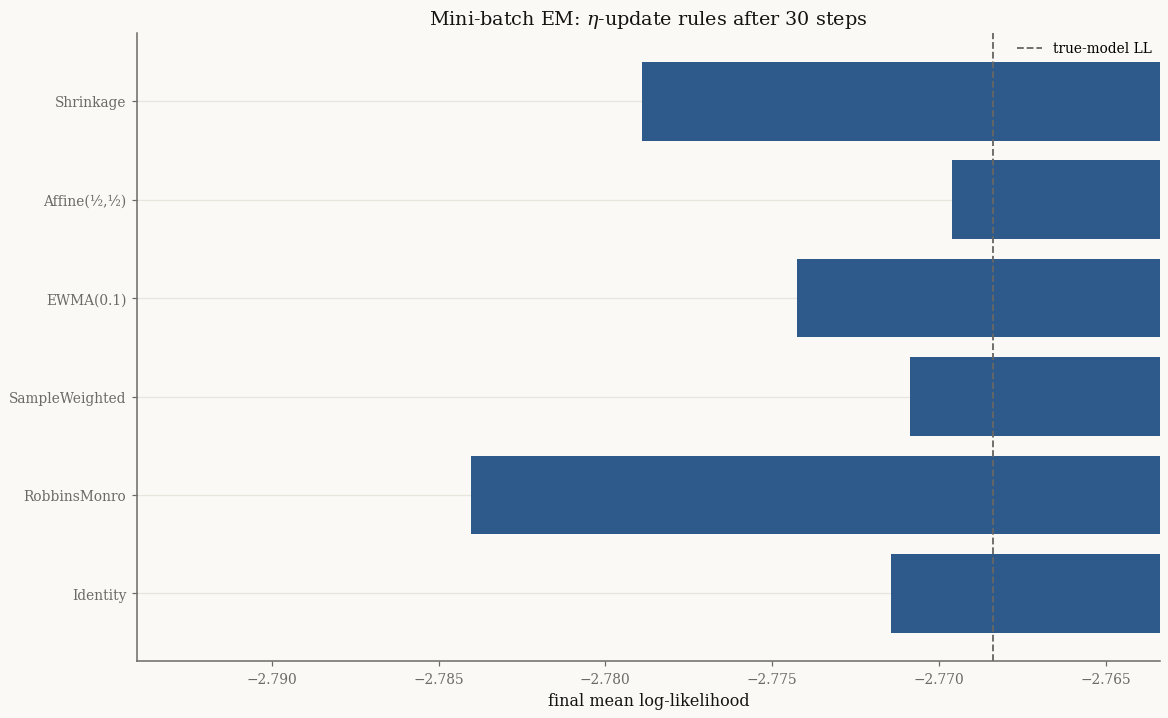
All rules climb to within a fraction of a nat of the true-model likelihood after
30 mini-batches. They differ mainly in how they get there — the averaging
rules (SampleWeighted, EWMA, Affine) damp the per-step noise, while
Identity and the decaying RobbinsMonro step are more volatile.
Following a single trajectory#
With verbose=1 the fitter records the log-likelihood at diagnostic
checkpoints, which we can plot to see the mini-batch ascent of two contrasting
rules:
fig, ax = plt.subplots()
for name, rule in [("Identity", IdentityUpdate()),
                   ("EWMA(0.1)", EWMAUpdate(w=0.1))]:
    res = IncrementalEMFitter(
        batch_size=512, max_steps=N_STEPS, eta_update=rule, verbose=1,
        e_step_backend="cpu", m_step_backend="cpu").fit(init, X, key=key)
    ll = np.asarray(res.log_likelihoods)
    ax.plot(np.linspace(0, N_STEPS, len(ll)), ll, marker="o", ms=3, label=name)
ax.axhline(target, color="0.4", ls="--", lw=1.2, label="true-model LL")
ax.set_xlabel("mini-batch step"); ax.set_ylabel("mean log-likelihood")
ax.set_title("Incremental EM trajectories")
ax.legend()
plt.show()
EM [incremental] NormalInverseGaussian: rule=IdentityUpdate, batch_size=512, max_steps=30, inner_iter=1
  step    3/30  LL=-2.775277  |Δparams|=6.8369e-02
  step    6/30  LL=-2.771501  |Δparams|=4.0041e-02
  step    9/30  LL=-2.787793  |Δparams|=6.6476e-02
  step   12/30  LL=-2.772647  |Δparams|=5.6552e-02
  step   15/30  LL=-2.768970  |Δparams|=3.9134e-02
  step   18/30  LL=-2.771232  |Δparams|=8.3946e-02
  step   21/30  LL=-2.770677  |Δparams|=4.3130e-02
  step   24/30  LL=-2.769282  |Δparams|=4.5298e-02
  step   27/30  LL=-2.769822  |Δparams|=4.0683e-02
  step   30/30  LL=-2.771450  |Δparams|=7.9296e-02
  Done (22.33s), final LL=-2.771450
EM [incremental] NormalInverseGaussian: rule=EWMAUpdate, batch_size=512, max_steps=30, inner_iter=1
  step    3/30  LL=-2.801727  |Δparams|=1.3692e-02
  step    6/30  LL=-2.795269  |Δparams|=9.1137e-03
  step    9/30  LL=-2.790216  |Δparams|=1.2854e-02
  step   12/30  LL=-2.786959  |Δparams|=3.7463e-03
  step   15/30  LL=-2.783138  |Δparams|=5.4757e-03
  step   18/30  LL=-2.780366  |Δparams|=5.6213e-03
  step   21/30  LL=-2.778214  |Δparams|=8.5632e-03
  step   24/30  LL=-2.776969  |Δparams|=5.9169e-03
  step   27/30  LL=-2.775718  |Δparams|=3.4815e-03
  step   30/30  LL=-2.774264  |Δparams|=4.8815e-03
  Done (23.12s), final LL=-2.774264
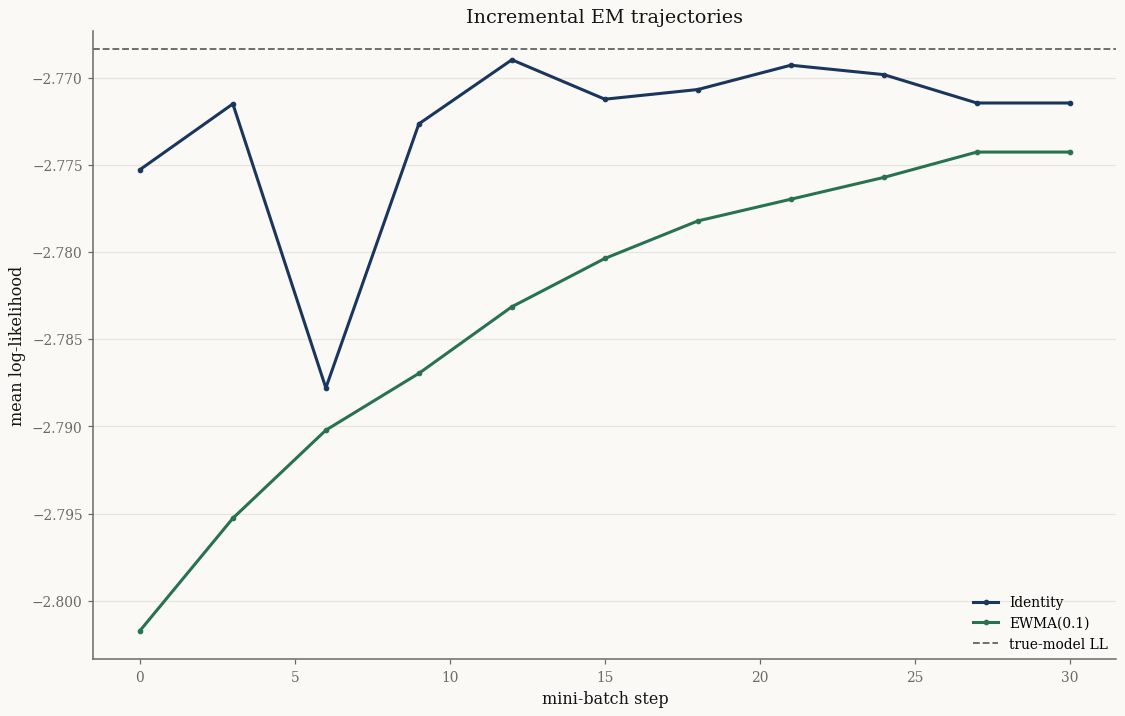
The Identity rule is noisier because it discards all history; EWMA
smooths the estimate across batches.
Shrinkage toward a target#
Shrinkage wraps any base rule and pulls the estimate toward a fixed
\(\eta_0\) — a regularizer for small batches or noisy streams. The targets module
builds sensible \(\eta_0\) values:
eta0_from_model(model)— the model’s own current expectation parameters.eta0_isotropic(model, sigma2)— isotropic covariance target.eta0_diagonal(model, diag)— diagonal covariance target.eta0_with_sigma(model, Sigma0)— explicit covariance target.
from normix import eta0_isotropic

rule = Shrinkage(RobbinsMonroUpdate(tau0=10.0), eta0_isotropic(init, 1.0), tau=0.5)
res = IncrementalEMFitter(
    batch_size=256, max_steps=N_STEPS, eta_update=rule,
    e_step_backend="cpu", m_step_backend="cpu").fit(init, X, key=key)
print("shrinkage-to-isotropic final mean log-lik:",
      float(res.model.marginal_log_likelihood(X)))
shrinkage-to-isotropic final mean log-lik: -2.8308698420638634
Takeaways#
IncrementalEMFitterupdates from mini-batches;fit(model, X, key=...)needs a PRNG key for batch sampling.Six \(\eta\)-update rules trade off memory vs responsiveness; averaging rules reduce variance,
Identityreacts fastest.Shrinkage+ theeta0_*targets regularize the online estimate toward a chosen structure.
Next: Initialization and multi-start looks at where the EM loop starts and how to make fits robust to local optima.