Bessel functions and log_kv#
The densities of the GIG and Generalized Hyperbolic distributions are written
in terms of the modified Bessel function of the second kind, \(K_\nu(z)\)
(DLMF §10). Evaluating it naively overflows and underflows badly,
and the standard library versions are neither JIT-able nor differentiable.
normix provides log_kv, a log-space implementation of \(K_\nu\) as a
192-point quadrature (two array backends):
jax.grad differentiates that sum; log_kv_moments writes the same
derivatives as expectations (shown below).
import jax
jax.config.update("jax_enable_x64", True)
import jax.numpy as jnp
import numpy as np

from normix import log_kv, log_kv_moments
from normix.utils.plotting import set_theme

set_theme()
np.set_printoptions(precision=6, suppress=False)
Two backends, one function#
log_kv has a JIT-able JAX backend (the
default) and a NumPy CPU backend. Both agree,
and both match
scipy.special.kve
(the exponentially-scaled Bessel function, \(K_\nu(z)\,e^{z}\), via AMOS
Amos1986 — used here as a reference, not a runtime path):
from scipy.special import kve

v, z = 1.7, 4.0
jax_val = float(log_kv(v, z))               # JAX backend
cpu_val = float(log_kv(v, z, backend="cpu"))  # numpy/scipy backend
ref = float(np.log(kve(v, z)) - z)           # log K_v = log kve - z

print(f"log_kv  (jax) = {jax_val:.12f}")
print(f"log_kv  (cpu) = {cpu_val:.12f}")
print(f"scipy   ref   = {ref:.12f}")
log_kv  (jax) = -4.173389418837
log_kv  (cpu) = -4.173389418837
scipy   ref   = -4.173389418837
Symmetry and vectorization#
\(K_\nu = K_{-\nu}\), and log_kv broadcasts over both arguments like any JAX
ufunc, so you can vmap or evaluate on grids directly:
print("K_v == K_-v :", bool(jnp.allclose(log_kv(0.5, 2.0), log_kv(-0.5, 2.0))))

vs = jnp.array([0.0, 0.5, 1.0, 2.0])
zs = jnp.linspace(0.5, 5.0, 4)
grid = log_kv(vs[:, None], zs[None, :])   # (4, 4) via broadcasting
print("grid shape:", grid.shape)
K_v == K_-v : True
grid shape: (4, 4)
Numerical stability in the tails#
For large \(z\), \(K_\nu(z)\) decays like \(e^{-z}\) and underflows to exactly zero in
double precision — so log(scipy.special.kv(...)) returns \(-\infty\). Because
log_kv works in log space throughout, it stays finite and accurate:
from scipy.special import kv

for z_big in [50.0, 200.0, 700.0]:
    with np.errstate(divide="ignore"):
        naive = np.log(kv(0.5, z_big))        # underflows to -inf for large z
    stable = float(log_kv(0.5, z_big))
    print(f"z = {z_big:6.1f}   log(kv) = {naive:>10}   log_kv = {stable:.4f}")
z =   50.0   log(kv) = -51.73022015006934   log_kv = -51.7302
z =  200.0   log(kv) = -202.4233673306293   log_kv = -202.4234
z =  700.0   log(kv) =       -inf   log_kv = -703.0497
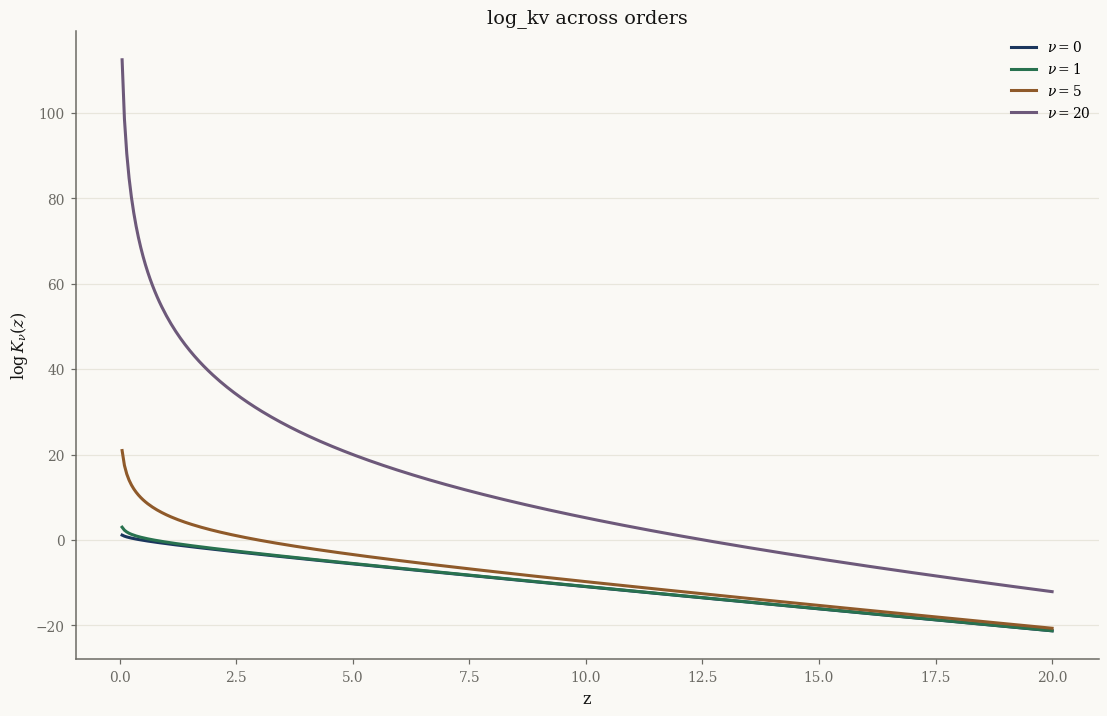
import matplotlib.pyplot as plt

zgrid = jnp.linspace(0.05, 20.0, 400)
fig, ax = plt.subplots()
for nu in [0.0, 1.0, 5.0, 20.0]:
    ax.plot(np.asarray(zgrid), np.asarray(log_kv(nu, zgrid)), label=f"$\\nu={nu:g}$")
ax.set_xlabel("z"); ax.set_ylabel(r"$\log K_\nu(z)$")
ax.set_title("log_kv across orders")
ax.legend()
plt.show()
How log_kv is computed#
\(K_\nu(z)\) has the whole-line integral representation (DLMF 10.32.9)
normix does not call a library Bessel routine. It replaces that integral by a
weighted sum of 192 function values (Gauss–Legendre quadrature, two panels).
That sum is the 192-node kernel. Both backend="jax" and backend="cpu"
evaluate the same sum; there is no regime dispatch.
The integrand of \(u \mapsto e^{\nu u-z\cosh u}\) peaks at
The code shifts \(x=u-u_0\) so the mass sits at \(x=0\), then places 96 nodes on
each side of the peak. Node locations are treated as constants
(stop_gradient); only the weights still depend on \((\nu,z)\).
Derivatives: autodiff and log_kv_moments#
Autodiff (automatic differentiation) is jax.grad: it differentiates the
JAX expression for log_kv. It is not a finite-difference stencil. Because the
nodes are frozen, that derivative is exactly an expectation under the 192-point
discrete measure:
log_kv_moments(v, z) evaluates those expectations from the same weights and
stores them as d_arg and d_order. So
jax.grad(lambda z: log_kv(v, z))(z)   # autodiff of the sum
log_kv_moments(v, z).d_arg            # the same expectation, written out
are the same calculation, two ways to read one quadrature:
v0, z0 = 1.3, 2.5
z_arr = jnp.array(z0)
ad_z = float(jax.grad(lambda z: log_kv(v0, z))(z_arr))
ad_v = float(jax.grad(lambda v: log_kv(v, z0))(jnp.array(v0)))
m = log_kv_moments(v0, z0)

print(f"jax.grad d/dz  = {ad_z:.12f}")
print(f"d_arg          = {float(m.d_arg):.12f}")
print(f"jax.grad d/dv  = {ad_v:.12f}")
print(f"d_order        = {float(m.d_order):.12f}")
jax.grad d/dz  = -1.283063098092
d_arg          = -1.283063098092
jax.grad d/dv  = 0.434938882251
d_order        = 0.434938882251
GIG’s \(\eta=\nabla\psi\) and Fisher \(H\) use log_kv_moments so the mean and the
\(3\times 3\) covariance come from one pass. Ordinary log_prob code can keep
using jax.grad(log_kv).
The \(z\)-derivative also matches the classical recurrence \(K_\nu'(z)=-\tfrac12\big(K_{\nu-1}(z)+K_{\nu+1}(z)\big)\):
recur = -0.5 * (
    float(jnp.exp(log_kv(v0 - 1, z0) - log_kv(v0, z0)))
    + float(jnp.exp(log_kv(v0 + 1, z0) - log_kv(v0, z0)))
)
print(f"recurrence d/dz = {recur:.12f}")
recurrence d/dz = -1.283063098092
Which backend should I use?#
backend="jax"(default) — use inside anything that is JIT-compiled, differentiated withjax.grad, or vectorized withjax.vmap, and on GPU. This is what distributionlog_probmethods call.backend="cpu"— the same sums in NumPy. Use it from Python EM loops (e_step_backend="cpu") that should not dispatch through JAX.
The two are numerically interchangeable; the choice is purely about performance and the surrounding execution context.
Takeaways#
log_kv(v, z)is a 192-point quadrature for \(\log K_\nu(z)\), not a call toscipy.special.kv.\(u_0=\operatorname{asinh}(\nu/z)\) is the mode of the integrand; nodes sit around that peak.
jax.grad(log_kv)is autodiff of that sum.log_kv_moments(v, z).d_argis the same \(\partial_z\) as an explicit average;d_orderis \(\partial_\nu\). Neither is a finite difference.Pick
backend="jax"for JIT/grad/vmap/GPU;backend="cpu"for a NumPy EM loop that should not enter JAX.
Next: Random sampling uses these densities to draw and validate samples from every distribution.