Random sampling#
Every normix distribution can generate samples through a uniform rvs(n, seed)
interface. Under the hood the methods range from textbook inverse-CDF sampling
to Devroye’s transformed density rejection (TDR) sampler for the GIG
(Devroye2014). This tutorial shows the interface, validates
the samplers against references, and explains the GIG sampling options.
import jax
jax.config.update("jax_enable_x64", True)
import jax.numpy as jnp
import numpy as np
from scipy import stats

from normix import (
    Gamma, InverseGaussian, GIG, MultivariateNormal,
    NormalInverseGaussian, GeneralizedHyperbolic,
)
from normix.utils.plotting import set_theme

set_theme()
The rvs interface#
rvs(n, seed) returns an array of n draws and is fully reproducible: the same
integer seed always yields identical samples.
g = Gamma(alpha=jnp.array(2.5), beta=jnp.array(1.5))
s1 = g.rvs(5, seed=0)
s2 = g.rvs(5, seed=0)
print("reproducible:", bool(jnp.array_equal(s1, s2)))
print("samples:", np.asarray(s1))
reproducible: True
samples: [1.20325347 1.02570646 2.96166115 0.25375372 1.54408211]
Validating univariate samplers#
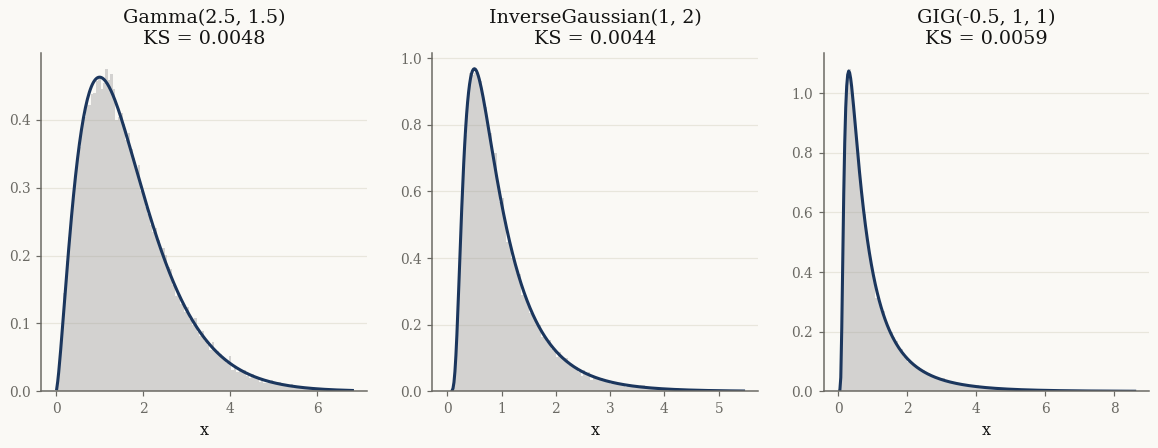
We draw from three univariate distributions and overlay the analytic density. The Kolmogorov–Smirnov statistic against the true CDF stays small:
import matplotlib.pyplot as plt

dists = {
    "Gamma(2.5, 1.5)": Gamma(alpha=jnp.array(2.5), beta=jnp.array(1.5)),
    "InverseGaussian(1, 2)": InverseGaussian(mu=jnp.array(1.0), lam=jnp.array(2.0)),
    "GIG(-0.5, 1, 1)": GIG(p=jnp.array(-0.5), a=jnp.array(1.0), b=jnp.array(1.0)),
}

fig, axes = plt.subplots(1, 3, figsize=(13, 4))
for ax, (name, d) in zip(axes, dists.items()):
    x = np.asarray(d.rvs(50_000, seed=1))
    ks = stats.kstest(x, lambda q: np.asarray(jax.vmap(d.cdf)(jnp.asarray(q)))).statistic
    grid = jnp.linspace(max(1e-3, x.min()), np.quantile(x, 0.999), 300)
    ax.hist(x, bins=120, density=True, range=(0, float(grid.max())),
            alpha=0.4, color="0.6")
    ax.plot(np.asarray(grid), np.asarray(jax.vmap(d.pdf)(grid)), lw=2)
    ax.set_title(f"{name}\nKS = {ks:.4f}")
    ax.set_xlabel("x")
plt.show()
GIG sampling methods#
The GIG is the only distribution with a genuine sampling choice. rvs accepts a
method:
"devroye"(default) — Devroye’s TDR sampler on \(w=\log x\) (Devroye2014); exact and the most robust across parameter regimes."pinv"— Polynomial-Interpolation-based Numerical Inversion (PINV; HormannLeydold2011, HormannLeydold2014); fast for repeated draws from a fixed parameter set."scipy"— delegates toscipy.stats.geninvgauss(reference / CPU only).
All three target the same distribution; their empirical moments agree:
gig = GIG(p=jnp.array(1.2), a=jnp.array(2.0), b=jnp.array(1.5))
print(f"{'method':>8s}   {'mean':>8s}  {'var':>8s}")
print(f"{'analytic':>8s}   {float(gig.mean()):8.4f}  {float(gig.var()):8.4f}")
for method in ["devroye", "pinv", "scipy"]:
    x = gig.rvs(100_000, seed=7, method=method)
    print(f"{method:>8s}   {float(x.mean()):8.4f}  {float(x.var()):8.4f}")
  method       mean       var
analytic     1.8273    1.4310
 devroye     1.8300    1.4258
    pinv     1.8281    1.4470
   scipy     1.8333    1.4347
Multivariate sampling#
For multivariate distributions rvs(n, seed) returns an (n, d) array. The
MultivariateNormal draws Gaussians:
mvn = MultivariateNormal.from_classical(
    mu=jnp.array([0.0, 1.0]),
    sigma=jnp.array([[1.0, 0.6], [0.6, 2.0]]))
Xn = mvn.rvs(20_000, seed=0)
print("shape:", Xn.shape)
print("empirical mean:", np.asarray(Xn.mean(axis=0)))
print("empirical cov:\n", np.cov(np.asarray(Xn), rowvar=False))
shape: (20000, 2)
empirical mean: [-0.01195784  0.98016401]
empirical cov:
 [[1.0095161  0.59840201]
 [0.59840201 1.97882088]]
Marginal vs joint sampling#
A mixture distribution exposes two samplers. The marginal rvs returns just
the observations \(X\); the joint rvs (on .joint) also returns the latent
subordinator draws \(Y\) used to generate them:
nig = NormalInverseGaussian.from_classical(
    mu=jnp.array([0.0, 0.0]),
    gamma=jnp.array([0.3, -0.2]),
    sigma=jnp.array([[1.0, 0.4], [0.4, 1.0]]),
    mu_ig=1.0, lam=1.5)

X = nig.rvs(10_000, seed=3)             # marginal: X only, shape (n, d)
Xj, Y = nig.joint.rvs(10_000, seed=3)   # joint: (X, Y)
print("marginal X:", X.shape)
print("joint    X:", Xj.shape, " Y:", Y.shape)
print("same draws:", bool(jnp.allclose(X, Xj)))
print("E[Y] =", float(Y.mean()))
marginal X: (10000, 2)
joint    X: (10000, 2)  Y: (10000,)
same draws: True
E[Y] = 0.9996950920607215
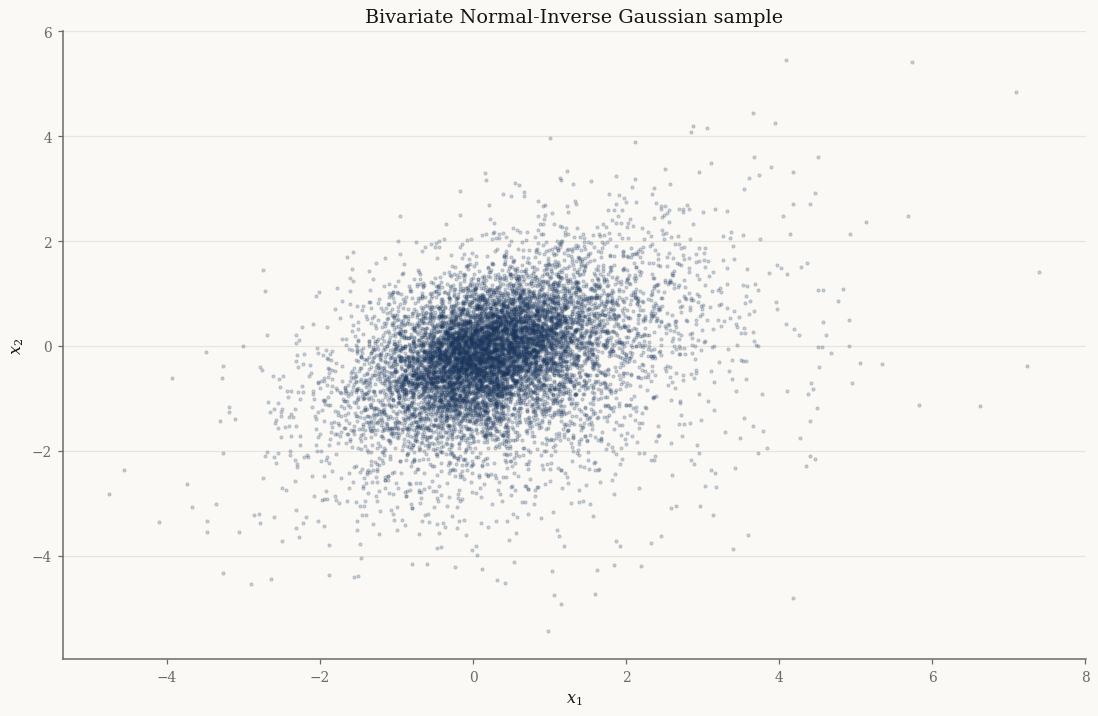
Having \(Y\) in hand is what makes the EM E-step possible: the conditional moments \(\mathbb{E}[\,\cdot \mid X]\) are computed from this latent structure.
fig, ax = plt.subplots()
ax.scatter(np.asarray(X[:, 0]), np.asarray(X[:, 1]), s=4, alpha=0.2)
ax.set_xlabel("$x_1$"); ax.set_ylabel("$x_2$")
ax.set_title("Bivariate Normal-Inverse Gaussian sample")
plt.show()
Takeaways#
rvs(n, seed)is the uniform, reproducible sampling interface; multivariate draws come back as(n, d).The GIG offers
method∈{"devroye", "pinv", "scipy"}, all sampling the same law —"devroye"(TDR; Devroye2014) is the robust default.Mixture marginals sample \(X\); their
.jointsamples \((X, Y)\) including the latent subordinator.
Next, the Univariate positive distributions tour exercises every constructor and method on the concrete distribution classes.