GIG#
The Generalized Inverse Gaussian is the parent of normix’s positive distributions: an exponential family on \((0, \infty)\) whose log-partition is Bessel-valued. Its density with parameters \((p, a, b)\) is
where \(K_p\) is the modified Bessel function of the second kind. It nests the Gamma (\(b \to 0\)), InverseGamma (\(a \to 0\)), and InverseGaussian (\(p = -\tfrac12\)).
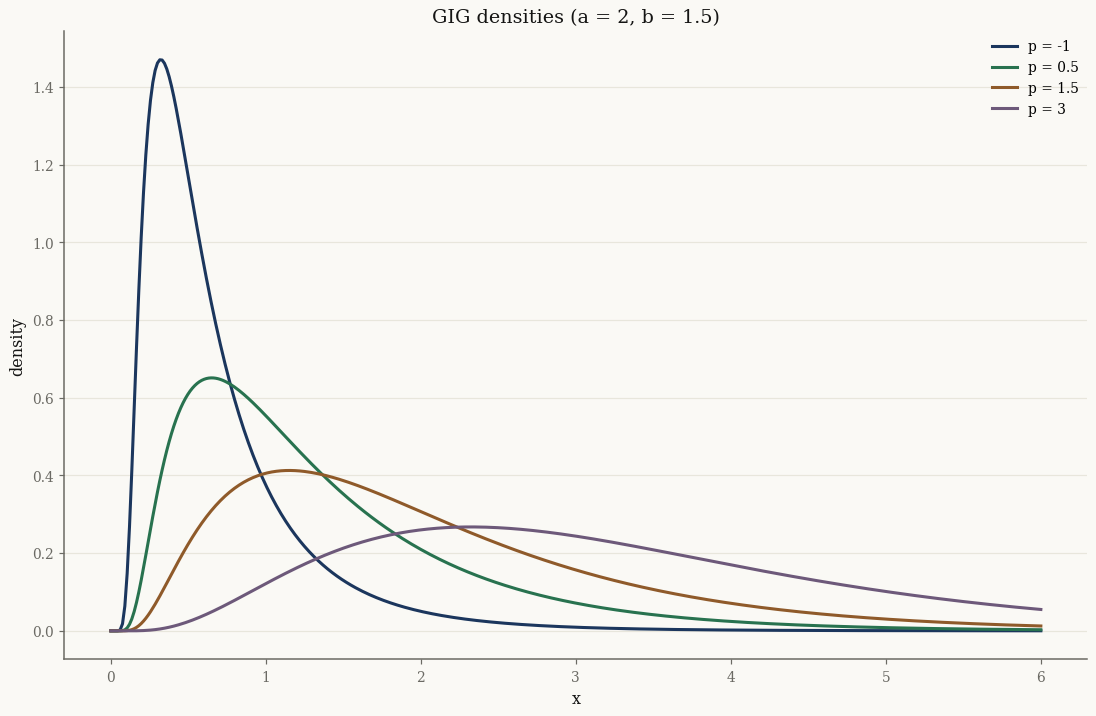
Density gallery#
The shape parameter \(p\) controls the behaviour near the origin (monotone for \(p \le 1\), unimodal with an interior mode for \(p > 1\)), while \(a\) and \(b\) set the scale and the two tails.
Parametrizations#
Stored attributes: p, a, b. As an exponential family with sufficient
statistic \(t(x) = [\log x,\; 1/x,\; x]\):
Parametrization |
Value |
|---|---|
Classical |
\(p \in \mathbb{R},\; a > 0,\; b > 0\) |
Natural \(\theta\) |
\([\,p - 1,\; -b/2,\; -a/2\,]\) |
Expectation \(\eta = \nabla\psi\) |
\([\,\mathbb{E}[\log X],\; \mathbb{E}[1/X],\; \mathbb{E}[X]\,]\) |
Inverting \(\eta \mapsto \theta\) is a strictly convex but stiff Bessel problem, solved by an \(\eta\)-rescaled multi-start Newton iteration. See The Generalized Inverse Gaussian Distribution for the derivation.
Quick usage#
gig = GIG(p=jnp.array(1.5), a=jnp.array(2.0), b=jnp.array(1.5))

print("mean/var/std:", float(gig.mean()), float(gig.var()), float(gig.std()))
print("pdf(1.0):    ", float(gig.pdf(jnp.array(1.0))))
print("5% quantile: ", float(gig.ppf(jnp.array(0.05))))

samples = gig.rvs(10_000, seed=0)          # Devroye exact sampler
fitted = GIG.fit_mle(samples)              # moment-match + multi-start Newton
print("fit (p,a,b): ", float(fitted.p), float(fitted.a), float(fitted.b))
mean/var/std: 2.0490381056766593 1.6740381056766491 1.2938462449907444
pdf(1.0):     0.4056682816793732
5% quantile:  0.5593202783302175
fit (p,a,b):  1.262973742131291 1.8621915334108148 1.7036540586571596
See also#
API:
GIGTutorial: The Generalized Inverse Gaussian — Bessel log-partition and the multi-start solver in depth