Reading the Prologue
The Prologue asks what changes in statistical reasoning when extreme outcomes matter. Its terminology is deliberately broader than a single asymptotic tail class. We use that question to separate three properties: a large fourth moment relative to variance, the existence of exponential moments, and the scaling of a survival function.
The source is Taleb (2025), Statistical Consequences of Fat Tails, third edition, arXiv:2001.10488v4, chapter 1, printed pp. 3–6. This discussion chapter states no numbered mathematical theorem. The calculations below and in the tail class catalog are our own teaching examples; the Prologue is their motivation, not their proof source.
| Source locator | Mathematical question to carry into the notes | Reading route |
|---|---|---|
| Ch. 1, p. 3 | Which hypotheses does a proposed statistical tool need? | Exponential moments and Pareto moment existence |
| Ch. 1, unnumbered terminology discussion, pp. 4–5 | Does a description relative to the Gaussian identify an asymptotic class? | The bounded counterexample below; catalog definitions and examples |
| Ch. 1, p. 6 | What can a calculation establish when a model assumption is uncertain? | Counting exceedances separates a finite count from a population probability |
The source uses “thick” in a Gaussian-relative, kurtosis-based sense, and “fat” more broadly than a strict power-law definition (ch. 1, pp. 4–5). Here we name the mathematical property explicitly. The Cramér condition asks for a finite positive exponential moment; regular variation asks for a limiting multiplier ratio; subexponentiality asks about the tail of an iid sum. None is defined by the word “fat” alone.
High kurtosis with bounded support
For a variable with finite fourth moment and positive variance, define its Pearson kurtosis, locally denoted by , as
This is kurtosis, not excess kurtosis . A standard Gaussian has : integration by parts with gives , where both integrals run over and is the standard normal density.
We prove that arbitrarily large kurtosis is compatible with bounded support and finite exponential moments. Fix a local probability and give the three-point law
Symmetry gives . Summing over the three atoms gives
For every real , the same finite sum gives
For each fixed the right tail ends at . It therefore cannot have a regularly varying tail with positive exponent, or belong to the unbounded-support subexponential class used here. Choosing smaller produces a different bounded law with larger kurtosis. It does not turn any one of these laws into a power-tailed distribution. For example, gives variance 1, kurtosis 100, and support .
Ordinary moments and tail classes
The catalog supplies a second contrast: a lognormal variable has all positive power moments finite but has no finite positive exponential moment. It is subexponential, yet not regularly varying. An exact Pareto variable has a positive power moment of order precisely when . The catalog proves the lognormal moment calculations and separates the cited classifications; the Pareto moment note owns the exact Pareto integral proof.
These examples answer different questions. A finite population variance requires a finite second moment. The kurtosis comparison requires a finite fourth moment as well. A finite Chernoff bound requires an exponential moment at the chosen positive parameter. A multiplier-ratio claim requires information arbitrarily far into the tail. A finite empirical fourth moment alone establishes none of those population assumptions.
Reproduce the model comparisons
From the installed repository environment, run:
Code
from xmath.incerto.tail_classes import bounded_spike_summary

for epsilon in (0.1, 0.01, 0.001):
    print(f"epsilon={epsilon:.4g}")
    for name, value in bounded_spike_summary(epsilon).items():
        print(f"  {name}: {value:.4g}")
Output
epsilon=0.1
  support_radius: 3.162
  mean: 0
  variance: 1
  kurtosis: 10
epsilon=0.01
  support_radius: 10
  mean: 0
  variance: 1
  kurtosis: 100
epsilon=0.001
  support_radius: 31.62
  mean: 0
  variance: 1
  kurtosis: 1000
Every law here has bounded support, so large kurtosis alone does not establish a heavy asymptotic tail.
Figure regeneration: uv run python demos/incerto/prologue_tail_classes.py.
The script evaluates specified probability laws in dimensionless units. There are no observed data, random draws, fitted parameters, or confidence intervals. It prints the three-point calculation for and the multiplier ratios for the catalog’s five unbounded models. A fixed 241-point grid spans , with multiplier ; runtime is bounded by this grid and two static figure exports, normally a few seconds.
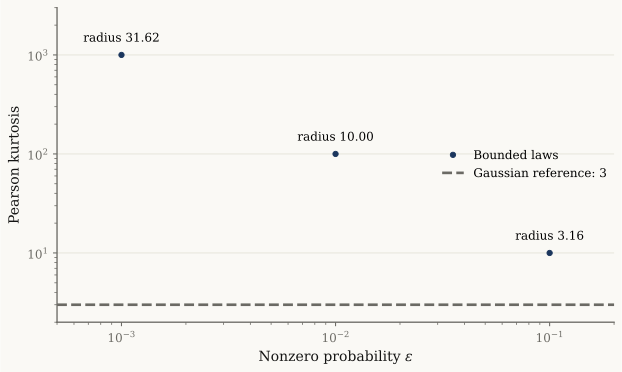
Exact three-point model calculations. Each marked law has finite support; the growing support endpoint is reported with each point. The Gaussian reference is Pearson kurtosis 3. No samples were generated.
The catalog figure shows why a vanishing multiplier ratio cannot by itself distinguish lognormal and Weibull subexponential tails from exponential and gamma tails. The code uses log survival functions to avoid dividing two underflowed probabilities; it stops on non-finite values rather than dropping them. Finite curves illustrate the models and do not prove their limiting classes.
References and next reading
Taleb, Statistical Consequences of Fat Tails, third edition (2025), arXiv:2001.10488v4, ch. 1, pp. 3–6; terminology on pp. 4–5. Source context only.
Tail class catalog: proofs, exact classification locators, and the model-ratio comparison.
SCoFT reading map: available chapter guides.
Symbols follow the shared notation. The Prologue supplies no equation-level notation to translate; and above are local to our counterexample. The book’s text and figures are not reproduced here.
- Taleb, N. N. (2025). Statistical Consequences of Fat Tails (3rd ed.). https://arxiv.org/abs/2001.10488v4