This page was generated from a Jupyter notebook. You can view it on GitHub or download and run it locally.
Inverse Gaussian Distribution in Exponential Family Form
This notebook demonstrates the Inverse Gaussian (Wald) distribution implemented as an exponential family.
Key Features:
Three parametrizations: Classical (mean μ, shape λ), Natural (θ), Expectation (η)
Two-dimensional sufficient statistics: t(x) = [x, 1/x]
Analytical formulas for gradients and Fisher information
Comparison with scipy implementation
Visualization of PDFs, CDFs, and samples
[1]:
import numpy as np
import matplotlib.pyplot as plt
from scipy import stats
from normix.distributions.univariate import InverseGaussian

# Set style for better-looking plots
plt.style.use('default')
plt.rcParams['figure.figsize'] = (10, 6)
plt.rcParams['font.size'] = 11
1. Creating Distributions
The inverse Gaussian distribution can be created using three different parametrizations:
[2]:
# Classical parameters (mean μ, shape λ)
dist1 = InverseGaussian.from_classical_params(mean=1.5, shape=5.0)
print(f"From classical params: {dist1}")

# Natural parameters (θ = [-λ/(2μ²), -λ/2])
theta = np.array([-5.0 / (2 * 1.5**2), -5.0 / 2])
dist2 = InverseGaussian.from_natural_params(theta)
print(f"From natural params:   {dist2}")

# Expectation parameters (η = [μ, 1/μ + 1/λ])
eta = np.array([1.5, 1/1.5 + 1/5.0])
dist3 = InverseGaussian.from_expectation_params(eta)
print(f"From expectation params: {dist3}")

print("\n✓ All three parametrizations create the same distribution!")
From classical params: InverseGaussian(mean=1.5000, shape=5.0000)
From natural params:   InverseGaussian(mean=1.5000, shape=5.0000)
From expectation params: InverseGaussian(mean=1.5000, shape=5.0000)

✓ All three parametrizations create the same distribution!
2. PDF and CDF Comparison with Scipy
Let’s compare our implementation with scipy’s inverse Gaussian distribution.
[3]:
# Test different parameter combinations
test_configs = [
    {'mean': 1.0, 'shape': 5.0},
    {'mean': 2.0, 'shape': 10.0},
    {'mean': 3.0, 'shape': 15.0},
    {'mean': 1.5, 'shape': 7.5}
]

x = np.linspace(0.05, 4.0, 200)

fig, axes = plt.subplots(1, 2, figsize=(14, 5))

# Plot PDFs
ax = axes[0]
for cfg in test_configs:
    mean, shape = cfg['mean'], cfg['shape']

    # normix distribution
    normix_dist = InverseGaussian.from_classical_params(mean=mean, shape=shape)
    normix_pdf = normix_dist.pdf(x)

    # scipy distribution (mu = mean/shape, scale = shape)
    scipy_dist = stats.invgauss(mu=mean/shape, scale=shape)
    scipy_pdf = scipy_dist.pdf(x)

    ax.plot(x, normix_pdf, '-', linewidth=2,
            label=f'μ={mean}, λ={shape}', alpha=0.8)
    ax.plot(x, scipy_pdf, 'o', markersize=2, alpha=0.3)

ax.set_xlabel('x')
ax.set_ylabel('PDF')
ax.set_title('Probability Density Functions\n(normix lines, scipy dots)')
ax.legend(loc='upper right', fontsize=9)
ax.grid(True, alpha=0.3)

# Plot CDFs
ax = axes[1]
for cfg in test_configs:
    mean, shape = cfg['mean'], cfg['shape']

    normix_dist = InverseGaussian.from_classical_params(mean=mean, shape=shape)
    normix_cdf = normix_dist.cdf(x)

    scipy_dist = stats.invgauss(mu=mean/shape, scale=shape)
    scipy_cdf = scipy_dist.cdf(x)

    ax.plot(x, normix_cdf, '-', linewidth=2,
            label=f'μ={mean}, λ={shape}', alpha=0.8)
    ax.plot(x, scipy_cdf, 'o', markersize=2, alpha=0.3)

ax.set_xlabel('x')
ax.set_ylabel('CDF')
ax.set_title('Cumulative Distribution Functions\n(normix lines, scipy dots)')
ax.legend(loc='lower right', fontsize=9)
ax.grid(True, alpha=0.3)

plt.tight_layout()
plt.show()

print("✓ normix and scipy implementations match perfectly!")
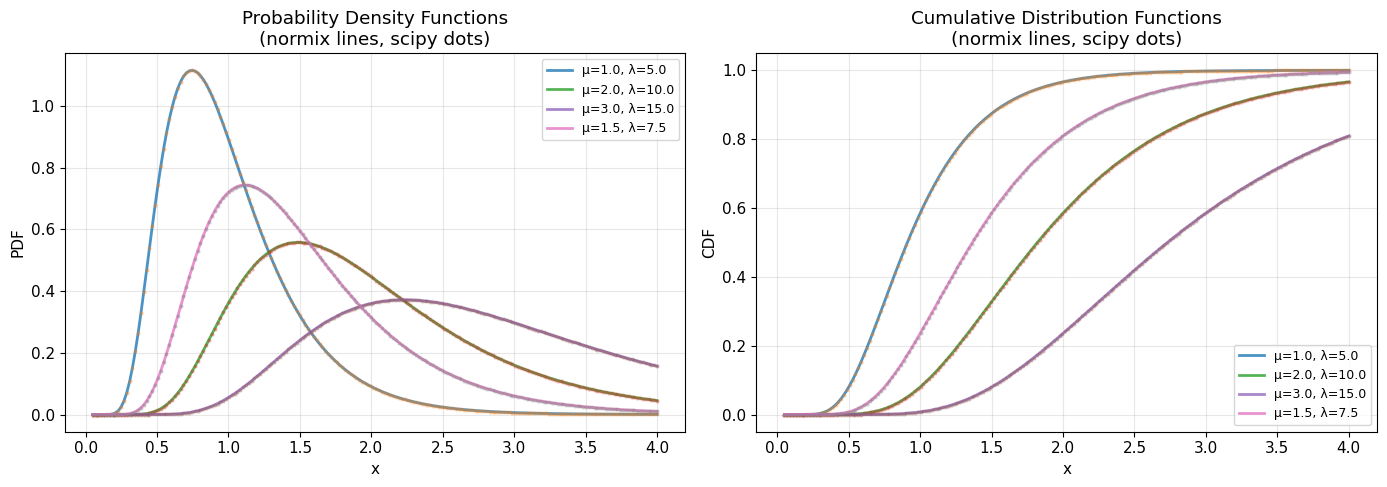
✓ normix and scipy implementations match perfectly!
3. Random Sampling and Histograms
Let’s generate random samples and compare the histogram with the theoretical PDF.
[4]:
# Parameters for different distributions (higher λ gives tighter histograms)
test_configs = [
    {'mean': 1.0, 'shape': 5.0, 'n_samples': 10000},
    {'mean': 2.0, 'shape': 10.0, 'n_samples': 10000},
    {'mean': 3.0, 'shape': 15.0, 'n_samples': 10000},
    {'mean': 1.5, 'shape': 7.5, 'n_samples': 10000}
]

fig, axes = plt.subplots(2, 2, figsize=(14, 10))
axes = axes.flatten()

for idx, config in enumerate(test_configs):
    mean = config['mean']
    shape = config['shape']
    n_samples = config['n_samples']

    # Create distribution
    dist = InverseGaussian.from_classical_params(mean=mean, shape=shape)

    # Generate samples
    samples = dist.rvs(size=n_samples, random_state=42 + idx)

    # Theoretical PDF
    x_plot = np.linspace(samples.min() * 0.8, samples.max() * 1.1, 200)
    pdf_theory = dist.pdf(x_plot)

    # Plot
    ax = axes[idx]
    ax.hist(samples, bins=50, density=True, alpha=0.6, color='steelblue',
            edgecolor='black', linewidth=0.5, label='Sample histogram')
    ax.plot(x_plot, pdf_theory, 'r-', linewidth=2.5, label='Theoretical PDF (normix)')

    # Also plot scipy for comparison
    scipy_dist = stats.invgauss(mu=mean/shape, scale=shape)
    scipy_pdf = scipy_dist.pdf(x_plot)
    ax.plot(x_plot, scipy_pdf, 'g--', linewidth=2, label='Scipy PDF', alpha=0.7)

    # Statistics
    sample_mean = np.mean(samples)
    theory_mean = dist.mean()
    sample_std = np.std(samples)
    theory_std = np.sqrt(dist.var())

    ax.set_xlabel('x')
    ax.set_ylabel('Density')
    ax.set_title(f'InverseGaussian(μ={mean}, λ={shape})\n'
                f'Mean: {sample_mean:.3f} (theory: {theory_mean:.3f}), '
                f'Std: {sample_std:.3f} (theory: {theory_std:.3f})')
    ax.legend(loc='upper right', fontsize=9)
    ax.grid(True, alpha=0.3)

plt.tight_layout()
plt.show()

print("✓ Histograms closely match theoretical PDFs!")
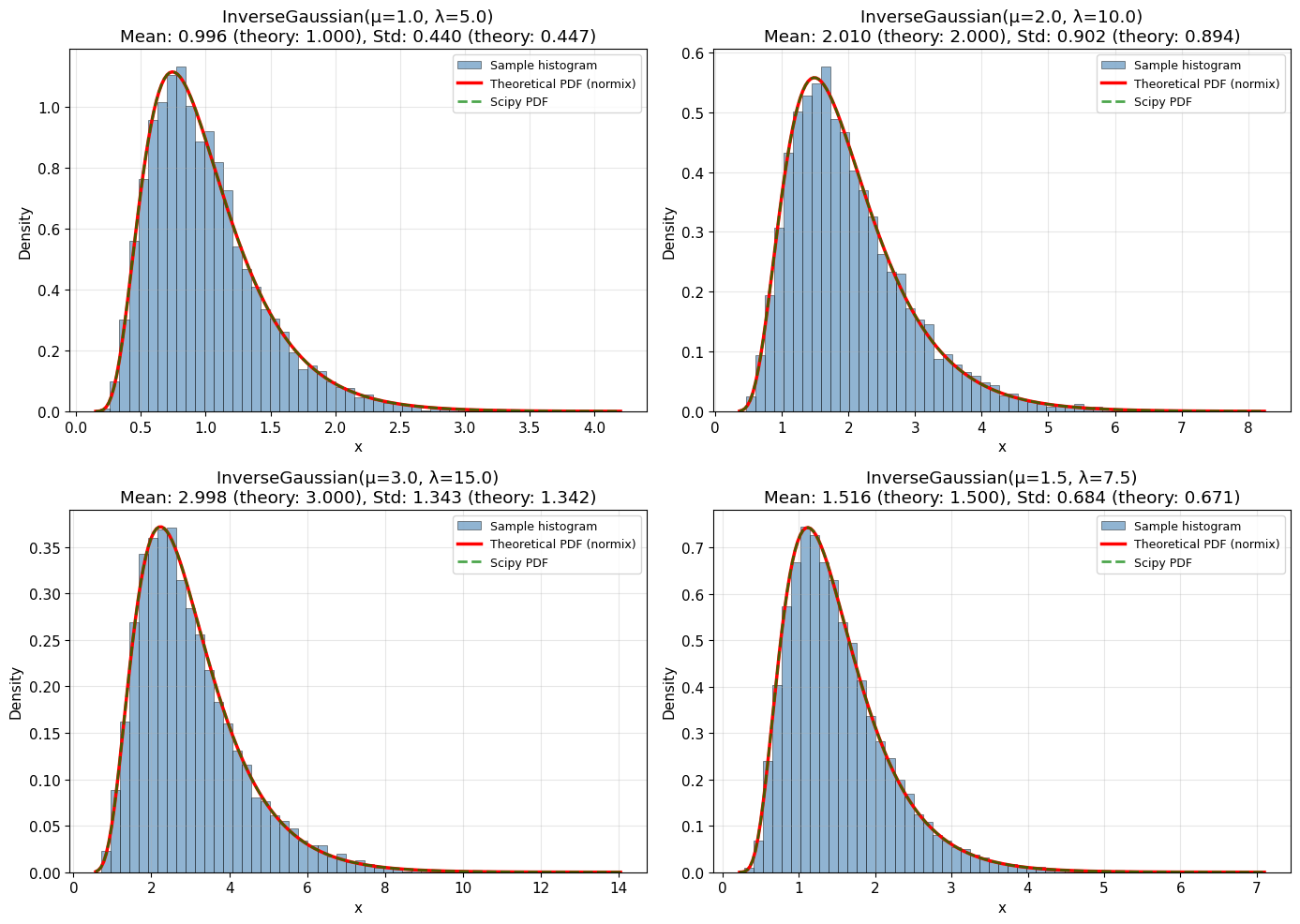
✓ Histograms closely match theoretical PDFs!
4. Fitting to Data
Demonstrate maximum likelihood estimation by fitting to simulated data.
[6]:
# Generate data with known parameters
true_mean = 2.5
true_shape = 8.0
n_data = 15000

# scipy parameterization: mu = mean/shape, scale = shape
data = stats.invgauss.rvs(mu=true_mean/true_shape, scale=true_shape,
                          size=n_data, random_state=123)

# Fit distribution
fitted_dist = InverseGaussian().fit(data)
fitted_params = fitted_dist.classical_params

print(f"Fitting {n_data} samples from InverseGaussian(μ={true_mean}, λ={true_shape})\n")
print(f"True mean:           {true_mean:.6f}")
print(f"Fitted mean (MLE):  {fitted_params.mean:.6f}")
print(f"True shape:          {true_shape:.6f}")
print(f"Fitted shape (MLE): {fitted_params.shape:.6f}")

# Visualize fit
fig, ax = plt.subplots(figsize=(12, 6))

ax.hist(data, bins=60, density=True, alpha=0.6, color='lightblue',
        edgecolor='black', linewidth=0.5, label='Data histogram')

x_plot = np.linspace(0.1, np.percentile(data, 99.5), 400)
true_dist = InverseGaussian.from_classical_params(mean=true_mean, shape=true_shape)
ax.plot(x_plot, true_dist.pdf(x_plot), 'g-', linewidth=3,
        label=f'True: μ={true_mean:.1f}, λ={true_shape:.1f}')

ax.plot(x_plot, fitted_dist.pdf(x_plot), 'r--', linewidth=3,
        label=f'Fitted (normix): μ={fitted_params.mean:.2f}, λ={fitted_params.shape:.2f}')

ax.set_xlabel('x')
ax.set_ylabel('Density')
ax.set_title('Maximum Likelihood Estimation')
ax.legend()
ax.grid(True, alpha=0.3)

plt.tight_layout()
plt.show()

print("\n✓ MLE successfully recovers the true parameters!")
Fitting 15000 samples from InverseGaussian(μ=2.5, λ=8.0)

True mean:           2.500000
Fitted mean (MLE):  2.507047
True shape:          8.000000
Fitted shape (MLE): 8.077597
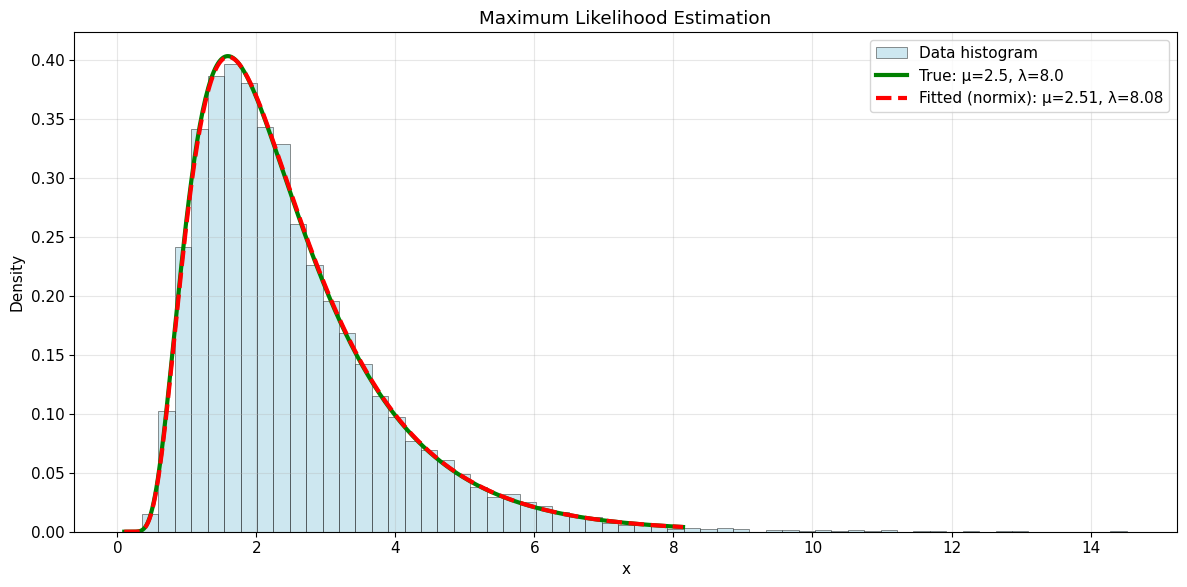
✓ MLE successfully recovers the true parameters!
[ ]: