An absorbing state changes which future payoffs a path can receive. Let be the first ruin time, taking values in ; the process stays ruined after . The probability law and expectation follow the shared notation.
Independent repeated exposure¶
Suppose trials are independent and each causes ruin with the same probability if reached. For every integer ,
with survival at defined as one. We prove both the finite formula and the limit: survival through is the intersection of independent nonruin events, hence the product. The events decrease to , so continuity of probability and give . At , survival is one at every horizon instead.
For , ruin probabilities at horizons 10, 100 and 1000 are approximately 0.182927, 0.867380 and 0.9999999983. No heavy-tail assumption enters this calculation.
What the dependence assumption can be replaced by¶
When , define the conditional hazard . The chain rule gives
This identity needs no independence assumption. If for all , eventual ruin has probability one if and only if . We prove the equivalence. If the sum diverges, forces the product to zero. If the sum converges, eventually and . The tail log-sum then has a finite lower bound; the finite initial product is positive, so the infinite product is positive. If some reached hazard is one, ruin is certain by that step separately.
A positive hazard at every step is insufficient. For ,
The formula follows by cancelling successive factors. It gives eventual ruin probability , although every conditional hazard is positive. For a different boundary, let all potential trial-failure indicators equal one Bernoulli variable with . Each marginal failure probability is , but for every : surviving the first trial reveals . Marginals alone do not determine repeated risk.
Growing ensemble expectation and a terminating path¶
Take , , and starting resource . Here denotes resources at step , not a mixing variable. Let
under the constant-hazard model. This gives . If , the expectation grows without bound. Nevertheless almost surely, so on almost every path eventually and
The proof is pathwise: after the finite ruin time the sum has only finitely many nonzero, finite terms, while its denominator grows. There is no contradiction with the expectation, which is carried by the increasingly rare surviving paths. With , and , the ensemble factor per step is 1.0192. This example proves a particular failure of interchanging a path limit and expectation; it is not a general ergodic theorem.
An absorbing barrier can also make the order of additive payoffs matter. Starting at 3, the increments lead to permanent ruin at the first step. Reversing them gives resources with no ruin. Both increment sums are zero. The rule here sets resources to zero on first reaching a nonpositive value and ignores all later increments.
Worked calculation and source scope¶
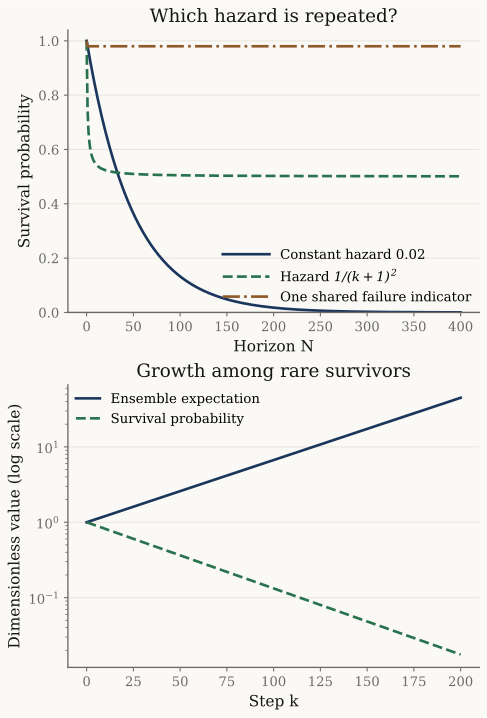
Exact finite-horizon curves. The summable-hazard model retains positive infinite-horizon survival. The lower panel uses , ; it compares ensemble expectation with survival, not with simulated paths.
Use survival_from_hazards, absorbing_resource_path.
from xmath.incerto.lecture_risk import survival_from_hazards, absorbing_resource_path

survival = survival_from_hazards([0.02] * 3)
print("Survival through step 3: [" + ", ".join(f"{v:.4g}" for v in survival) + "]")
for increments in ([-4, 4], [4, -4]):
    path = absorbing_resource_path(3, increments)
    print(f"{increments}: [" + ", ".join(f"{v:.4g}" for v in path) + "]")
Output
Survival through step 3: [1, 0.98, 0.9604, 0.9412]
[-4, 4]: [3, 0, 0]
[4, -4]: [3, 7, 3]
Ruin is absorbing.
Figure regeneration: uv run python demos/incerto/lecture_risk.py. The grids contain
and ; the two ordered increment
examples are printed separately. There is no RNG or external data.
The chapter context is Taleb (2025), ch. 3, §3.11, pp. 63–66. The attached precaution paper, v1, §II.B and §III, pp. 2–3, discusses irreversible failure and repeated risk. Our proofs supply explicit hazard assumptions and counterexamples to an unqualified eventual-ruin claim. The paper’s policy and infinite-cost arguments are not conclusions of these probability calculations.
- Taleb, N. N. (2025). Statistical Consequences of Fat Tails (3rd ed.). https://arxiv.org/abs/2001.10488v4