Writing / 2026
Harari’s Imagined Imagined Communities
A critique of Harari’s account of shared stories and large-scale cooperation.
Image note: the original text’s positional references are retained; article images are collected at the end because their positions are unknown.
Imagined “imagined communities”
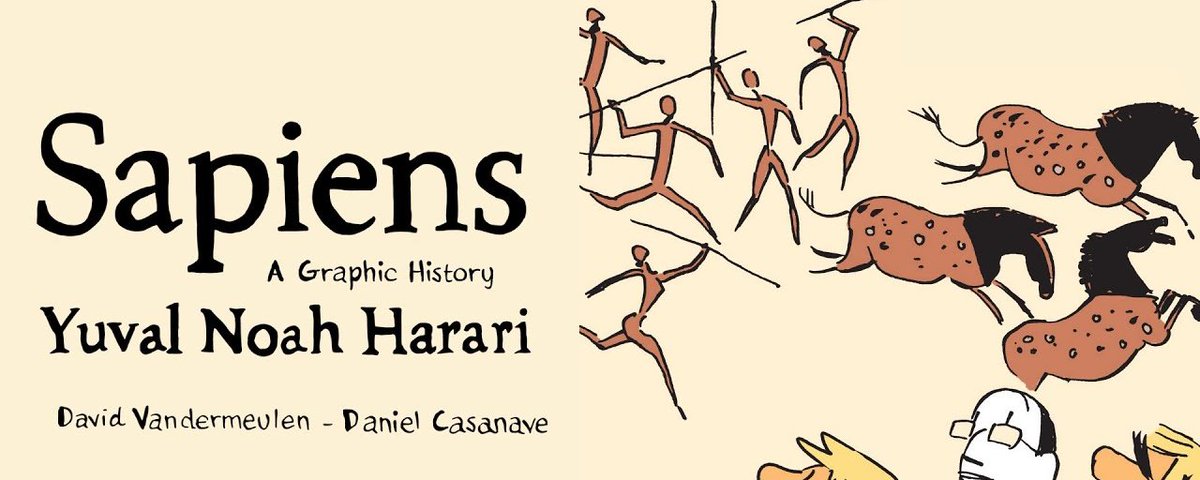
In Sapiens, Yuval Noah Harari (尤瓦尔·赫拉利) makes a widely repeated argument: humans “stand out” among animals because of large-scale, flexible cooperation. Greater physical strength or smarter individual brains cannot explain it. Such cooperation is possible because we can jointly believe in things that do not exist as physical entities: religious myths, nation-states, laws, companies, money, human rights. He calls them shared myths that exist in the “collective imagination,” and a company a “legal fiction.”
People on the Chinese internet often bring up this argument, most recently in a video by Zhengquejun (正确君). It sounds persuasive, too. I was among the earliest people to watch Harari’s course on Coursera. His patient storytelling made me feel, back then, as if the clouds had parted. Looking at it again all these years later, collective imagination certainly exists, and money does need shared recognition to function. The central problem is that Harari stuffs several completely different kinds of things into one word, fiction, and adds a simple causal chain: once stories and collective imagination exist, large-scale, flexible cooperation appears as if someone had flipped a switch. When concepts are mixed together, the actual causality becomes hard to test.
Big history, big concepts
A common problem with “big history” and grand narratives is that they create a broad, abstract concept and then use it to explain all sorts of problems. It reads like a grand unified theory in physics. Because the scope is so broad, the author can easily cherry-pick evidence and construct plausible-sounding causal claims that are difficult to falsify.
For Harari, this big term is “imagined communities,” “shared imagination,” and the “stories” (fiction) he so often invokes. States, companies, religions, mythical creatures, Harry Potter: all fit into the same framework.
If we take this fiction apart, we may find that these things do not belong to the same category at all.
A. Predictions later falsified. A prehistoric cave painting shows a winged horse. To modern people who have traveled the globe and know modern biology, this is obviously a nonexistent creature, an imagining. It need not have been so for the people of that time. Given their limited information, it could have been a reasonable conjecture: a simple hypothesis about the world before people had mastered the scientific method. This is what Taleb’s The Black Swan is about: you cannot conclude that black swans do not exist just because you have only seen white ones. Intelligent beings, whether humans or some alien civilization, make predictions with limited information. Nobody can be omniscient and infallible from the start. Conjectures that were later proved wrong become “fictional imaginings” in Harari’s account.
B. Deliberately invented fiction. Novels, films, bedtime stories for children: both the author and the audience know they are made up. Reading Journey to the West (《西游记》), you do not really believe in the magical seventy-two transformations, and storytellers entertaining children do not expect them to take it all literally. Such fiction is sometimes entertainment, sometimes education, and occasionally fraud. These stories may greatly influence our history and society, but it is hard to establish that they directly cause large-scale human cooperation.
C. Abstract concepts rooted in reality. One apple and two apples are abstracted into numbers. Numbers themselves do not exist in the physical world, but with them we can use the same method to count fruit and sheep. States, companies, and laws are close to this category: as society becomes more complex, people inevitably need these concepts to understand society and explain how it works. They are not necessarily sufficient conditions for large-scale cooperation, but they are necessary ones. They need not be precise descriptions; some models may be wrong but useful. Even Newton’s equation of universal gravitation is only an approximation of the macroscopic world, and no physicist considers Einstein’s relativity to be absolute truth. Harari puts these abstractions into the category of fiction as well.
D. Living religions. Religion is often placed entirely in B, treated as “stories made up for ordinary people” or “a tool of rulers,” or in A, as mistakes made by ancient people who did not know enough. But by Popper’s standard, the truly durable layer of religion is the unfalsifiable one: whether the universe has meaning, whether souls exist, where we go after death. “God exists” is neither a natural prediction that has already been falsified nor entertainment that everyone knows is made up.
The falsifiable parts have kept changing with the times. After geology and biology overturned a young Earth and a literal seven-day creation, many churches read “days” as ages and creation as allegory. In 1996, John Paul II acknowledged that evolution was “more than a hypothesis.” Catholicism did not abandon its faith; it pulled back the layer that could be overturned by empirical evidence. There was another, more interesting revision: in 1844, William Miller’s followers predicted that Jesus would return to Earth that year. He did not come. Some of them then said that what happened that day was an event in the heavenly sanctuary, invisible to human eyes. Jehovah’s Witnesses later made a similar move with 1914: a visible end of the world became Christ’s invisible enthronement in heaven. A failed prediction that could be checked against a date was explained away as an event that could no longer be checked. Religion rewrites A as an unfalsifiable proposition and then continues to spread.
These four categories differ in their definitions, origins, and effects on human society and history. Mix them together, and a curious bit of magic happens.
You see, complex societies do need C to function. So how do you prove that C causes large-scale cooperation? Just show that C came earlier. Oh, right, A seems to have appeared before that. Since A and C are the same thing, the causal argument is “complete.”
But is that really how it works?
Stories and cooperation do not run in just one direction
For a fictional thing to spread and become “shared imagination,” there must first be a communication system that is good enough. For prehistoric humans, that could be the simplest language, or paintings on cave walls, the beginnings of pictographic writing. That communication system also happens to be a necessary condition for large-scale, flexible cooperation.
Appearing at the same time, or one after the other, does not establish causality. So the real question is: why should “shared imagination” and “large-scale, flexible cooperation” have a causal relationship, rather than both being results of “intelligence + complex communication abilities”?
Harari gives no answer.
We can imagine that humans first cooperated when several groups came together to hunt large animals they could not handle alone, such as mammoths. Basic communication was necessary: there is a herd of mammoths to the northeast; there are crocodiles in this river. Other things could of course come along for the ride, such as a winged horse carved into stone. For Harari’s causal chain to hold, he would have to show that the opposite scenario did not occur. He would have to show that several groups first believed together in a winged horse and only then began hunting together. The overlap of two things in history is not enough evidence to establish that sequence.
Cooperation can also break down without a story first being rewritten. In Science in 2026, Sandel and colleagues reported a permanent split among the Ngogo chimpanzees in Kibale, Uganda. The western and central clusters, which had previously mixed, began avoiding each other in 2015, split into two groups in 2018, and then the western group began sustained lethal attacks on the central group. They had shared territory, groomed together, and bred together. After the split, individuals who had been together just yesterday became targets of attack. Thirty years of observation show that group identity can shift without language, group markers, or ideology, and can escalate into killing. Clearly, the western and central groups did not start killing each other because they had converted to a different myth.
Another way to look at this is survivorship bias. Societies kept stories that helped coordination and discarded those that did nothing for social development or group competitiveness. The “stories” we see now may be just a small fraction selected by history. We do not know how many different “stories” circulated among human groups during the long ages before writing was invented. Nor can we expect to fix a complex institution today simply by swapping one story for another, just as natural selection does not mean animals “chose” good genes; the environment eliminated poorly adapted ones.
Let me also mention two other pieces of evidence Harari himself has used. He writes that Neanderthals had larger brains, so the success of Homo sapiens was “not because they were smarter, but because they could invent fiction,” trying to strip “intelligence” out of the argument as a common cause. Yet we now know that larger brains do not mean higher general intelligence: Pearce, Stringer, and Dunbar (2013) pointed out that Neanderthals had larger eye sockets, and more of their neurons may have been devoted to vision.
On the other hand, Trut’s (1999) silver fox breeding experiment showed that selecting only individuals that were less fearful and less aggressive toward humans changed behavior and even appearance within a few dozen generations. “Trust” can act as a selection pressure on its own, without a shared story coming first. Dogs did not become our friends because of imagined communities.
Institutions are not switches
In Harari’s narrative, large-scale cooperation works like a switch: a group believes the same story, and cooperation happens. But complex institutions emerge through a long historical process, not all at once.
A tribe’s alpha can know every member and maintain order through personal relationships. Other social primates live this way too. Robin Dunbar inferred a number from primate neocortex size: the circle humans can stably maintain through personal relationships is roughly 150 people. The exact number is disputed, but that is the general scale. Beyond that circle of acquaintances, you cannot know and be familiar with everyone, let alone a thousand people. Categories must then be introduced: who handles food, who handles fighting, who owes how much to whom. Once the categories are shared and governance follows them, population and social complexity can grow further. This is a positive feedback process from simple to complex. Nobody first writes a complicated constitution and thereby turns a tribe into a state from the top down.
And “categorization,” this ability to simplify problems, does not even require a very complex brain. Prehistoric people only need to remember that rattlesnakes are venomous, without separately remembering every rattlesnake they have ever seen. When Benedict Anderson says a nation is “imagined,” he means that the vast majority of its members will never meet. But there is nothing strange about this. A person does not need to know every rattlesnake alive in the world either. People can naturally categorize living things by appearance, even if the categories are not accurate by modern biological standards. They can also categorize by geography, clothing, skin color, and language, forming the earliest nations.
We can do a thought experiment. Suppose there is a very intelligent prehistoric person who cannot learn our language and cannot listen, read, or write. He relies only on observation. He sees people walk into McDonald’s, hand over a patterned piece of paper, and receive food from a uniformed employee. He does not need to understand company law or a market economy to derive a rule from repeated events: enter a place with that sign, pay, and you get food. As he keeps watching, he notices that paper money can also be obtained by selling things or doing certain things (work). Even if he knows absolutely nothing of our “stories,” he can survive by learning these observed regularities. One day this McDonald’s closes, and the rule of walking in and exchanging money for food stops working. At the same time, a KFC with a different sign opens nearby. He still understands nothing about laws or companies, but after observing repeatedly, he revises his earlier theory and enters the new shop. He may have his own explanation for these phenomena. Nobody needs to know his explanation, and he does not need to know ours. As long as both sides can learn the patterns in each other’s behavior, basic cooperation can happen.
Beyond true and false, there is risk
Harari makes “true or false” his main axis of classification: fiction is false, and the physical world is real. He later makes this yardstick more specific, and does so repeatedly. In Homo Deus, he asks how we can tell whether an entity is real or fictional. “Very simple – just ask yourself, ‘Can it suffer?’” If Zeus’s temple burns down, Zeus does not suffer. If the euro depreciates, the euro does not suffer. If a bank goes bankrupt, the bank does not suffer. If a state loses a war, the state does not suffer either. “It’s just a metaphor.” The ones who suffer are wounded soldiers, starving farmers, and cows whose calves have been taken away. In a 2017 TED conversation, he repeats: If it can suffer, it’s real. If it can’t suffer, it’s not real. Physically, Jerusalem is just stones, trees, buildings, people, dogs, and cats. When people fight wars, they are fighting over imagined stories, not these things.
As a reminder “not to sacrifice living people for the word nation,” this seems morally powerful. But as a way to distinguish reality from fiction, it is rather odd. Stones do not suffer, the Earth’s crust does not suffer, numbers do not suffer, and neither gravity nor mathematical models feel pain. Should they all be classified as fiction?
Another interesting question is a debate in the style of “a white horse is not a horse.” An individual horse can suffer, but what about “horse” as a biological category? If we add a color modifier, can “white horse” suffer?
When he discusses Jerusalem, he again describes stones, trees, and cats as physical reality. In practice, he switches between two yardsticks: when he wants to show that states, money, and companies are fictional, he asks “can it suffer?” When he wants to preserve the objective world, he asks “does it exist in physical space?” Suffering identifies the capacity to feel, not whether something is real. The fact that a state cannot suffer does not imply that it is fictional in the same way as Harry Potter; it only shows that a state is not an organism with a nervous system.
In Sapiens, Homo Deus, 21 Lessons for the 21st Century, and many interviews, he repeatedly emphasizes truth, but rarely pauses over something more practical: if this statement is wrong, what is the cost? The rattlesnake mentioned above is one example. You can refuse to believe that this rattlesnake you have never seen before is venomous, or invent a story saying it is harmless, but you will still die if it bites you. Venom does not need shared imagination to keep working. The shape of the Earth is a different matter. The Earth is round, but this fact is of no use to a prehistoric tribe living in the jungle. Believing the Earth is flat will not stop them from catching their prey.
The Soviet Union did not dissolve by a wizard’s spell
In the passages about imagined orders in Sapiens, Harari describes the Soviet Union’s collapse as if a wizard’s spell had stopped working: people stopped believing the Soviet story, and so the Soviet Union disappeared.
The analogy is vivid, but irresponsible coming from a historian. Many complex causes lay behind the Soviet Union’s dissolution: prolonged economic stagnation, the fiscal burden of the arms race, nationalist movements in the constituent republics, Gorbachev’s reforms spinning out of control, and the failed coup of 1991. Each can be studied on its own, and each can be challenged. Harari simply compresses them into “the story stopped working,” reducing a historical process that lasted years to a simple switch.
The bigger problem is that history becomes not only a simple switch in his telling, but a switch of belief: believe, and it exists; stop believing, and it suddenly vanishes. Following this logic, any institutional collapse can be reduced to people “no longer believing,” to the story failing, while the underlying material conditions, power structures, and path dependence are all bypassed. A country whose economy is still growing and whose military faces no external threat is unlikely to dissolve because everyone suddenly stops believing one day. The loss of trust is often a consequence, not a cause.
In the chimpanzee example, there was neither a Soviet Union nor a wizard casting spells. Relations between groups broke down first; the split followed. Chimpanzees can cooperate, split, and kill each other without fiction. That shows that both group coordination and group breakdown can occur before shared stories appear.
This article was translated from the Chinese original posted on X.