Writing / 2024
Farewell, Yann LeCun
On Yann LeCun, scientific metrics, and having skin in the game.
Image note: the original text’s positional references are retained; article images are collected at the end because their positions are unknown.
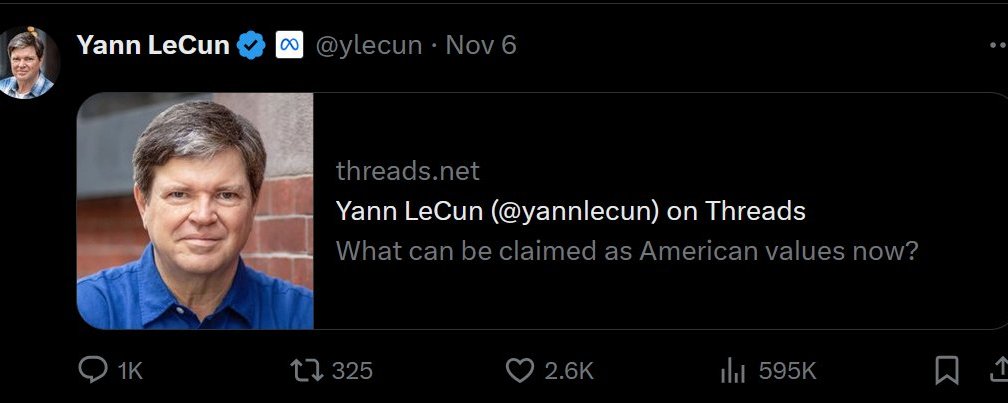
This is my first article since subscribing to X, and it happens to coincide with the departure of the great AI scientist and Turing Award winner Yann LeCun. After months of trading barbs with Elon Musk (mostly one-sided, from Yann himself), he seems to have finally lost his composure.
At first I was on Yann’s side. After all, Elon had made a complete fool of himself over convolutional neural networks (CNNs). There is no question that Tesla’s vision-based self-driving system depends on convolutional neural networks. Model architectures can take all sorts of forms, but they still rely on convolution to process images.
But as time went on, Yann LeCun began attacking Musk in other areas, perhaps because of his politics. Unfortunately, in areas he knew nothing about, he displayed astonishing ignorance. Nassim Taleb, the author of The Black Swan, has a good term for people like this: Intellectual Yet Idiot (IYI).
The IYI is a bit like what we call a small-town exam whiz: someone who treats all sorts of metrics as ends in themselves rather than means, such as exam scores, or Yann LeCun’s favorites, publications and citations.
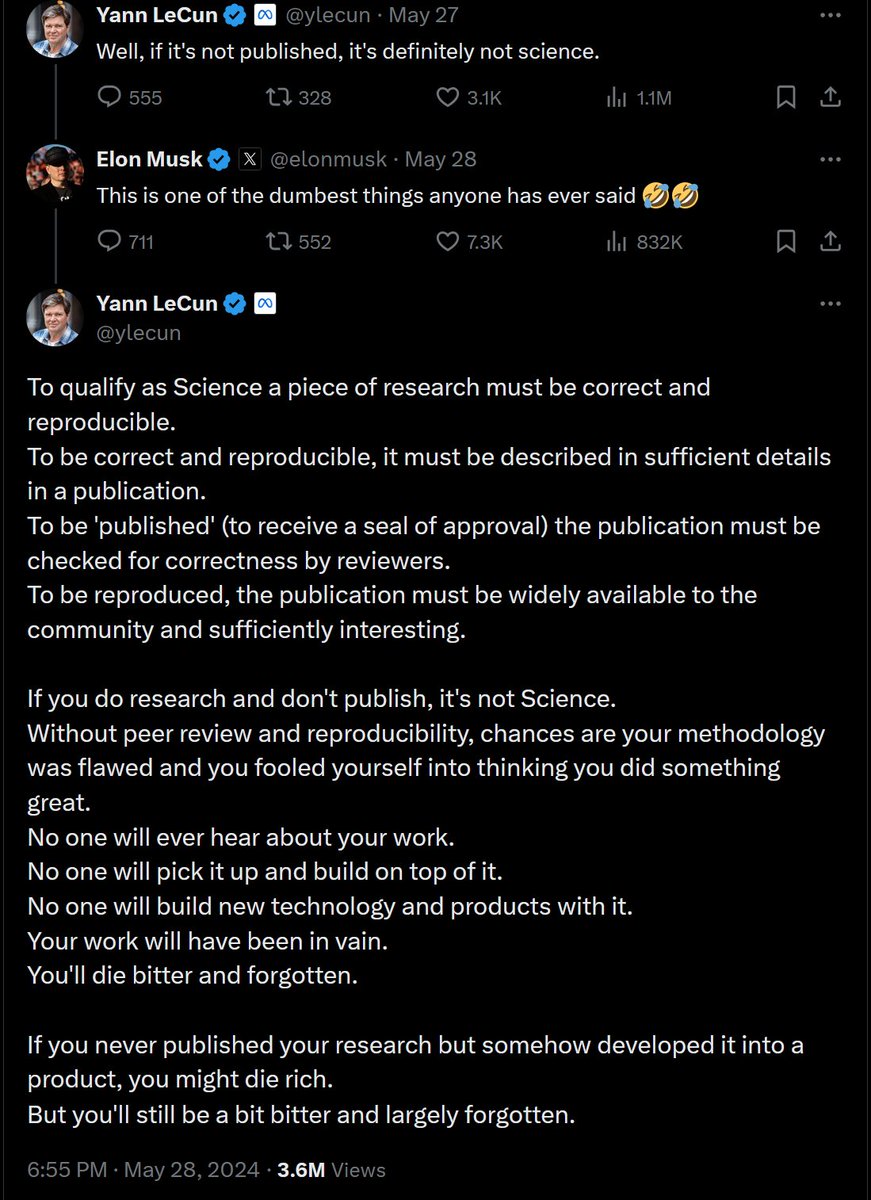
IYIs love very long chains of logic, which make their arguments look more rigorous. But the very first link in Master Yann LeCun’s chain is already absurd: to ensure correctness and reproducibility, scientific research must go through publication and peer review. This is the familiar mistake of equating IQ scores with intelligence, or scores on the College English Test, Bands 4 and 6, with English proficiency. Papers, peer review, and replication are ways of ensuring scientific rigor, but they have never been the same thing as scientific truth. Science has always been a way to apply knowledge and solve problems. If Tesla successfully builds an intelligent robot, you do not need to publish a paper laying out the technical details so that others can judge whether your achievement is “scientific.”
Yann LeCun is lucky. In his field, reproducing someone else’s results is very easy. We have to acknowledge that the open-source approach he advocates has been crucial to AI’s rapid development. Most machine learning papers come with open-source code, and that code is very likely built on an open-source framework such as PyTorch. With the hardware available, a good researcher needs only a few days to reproduce someone else’s model and adapt it to their own use case. Under these conditions, a good model, such as the transformer architecture, can spread quickly among researchers.
Other fields are a different matter, especially “soft sciences” such as social science, behavioral science, and economics. A typical example is the behavioral scientist Francesca Gino. Her famous 2012 paper about how the position of a signature can reveal whether someone is honest was not found to be irreproducible until 9 years later. She was not fired by Harvard until 2023. I recommend this episode of the Freak Economics Podcast.
So far, that disputed paper still has more than 500 citations on Google Scholar. She herself has faced no substantive punishment, and her bestselling books are still selling well on Amazon. Her h-index on Google Scholar is as high as 92. By Master Yann LeCun’s logic, her contribution to “science” must vastly exceed that of Elon Musk, who has no papers.
When IYIs mistake means for ends and metrics for facts, they become easy to fool. Students can raise their scores through all sorts of “techniques” designed specifically for exams. In academia, trading citations is hardly unusual. Another common phenomenon is the misuse of statistics. If everyone uses the p-value as the universal criterion for whether a paper can be published, p-hacking becomes inevitable. When everyone uses the wrong statistical methods, whether the results can be “reproduced” becomes meaningless.
Yann LeCun clearly cannot understand any of this, so he displays the same confidence when discussing economics and politics as he does in machine learning.
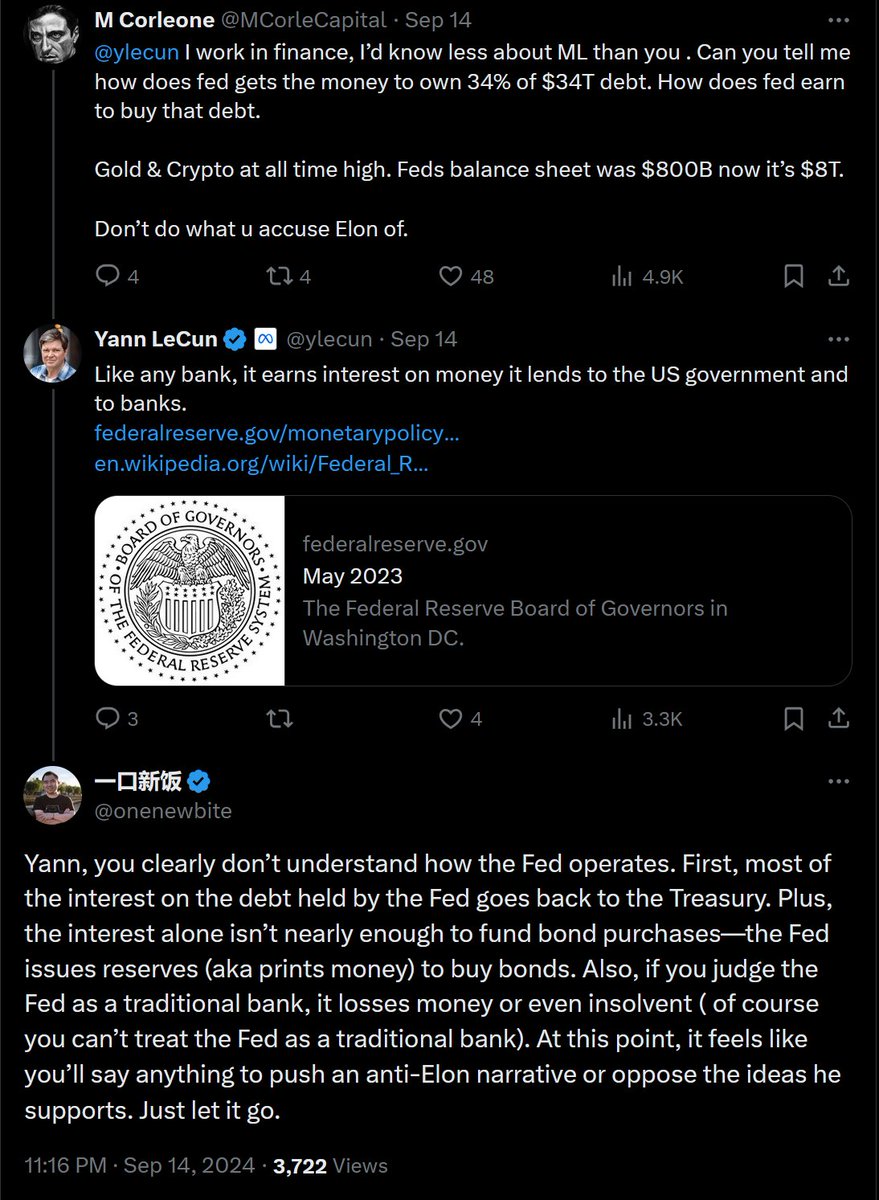
Yann LeCun’s understanding of banking may still be at the level of our secondary-school general education. He seems to think official explanations and Wikipedia are enough to understand how the Federal Reserve really works. A fondness for textbook “standard answers” and official, authoritative explanations is another IYI trait.
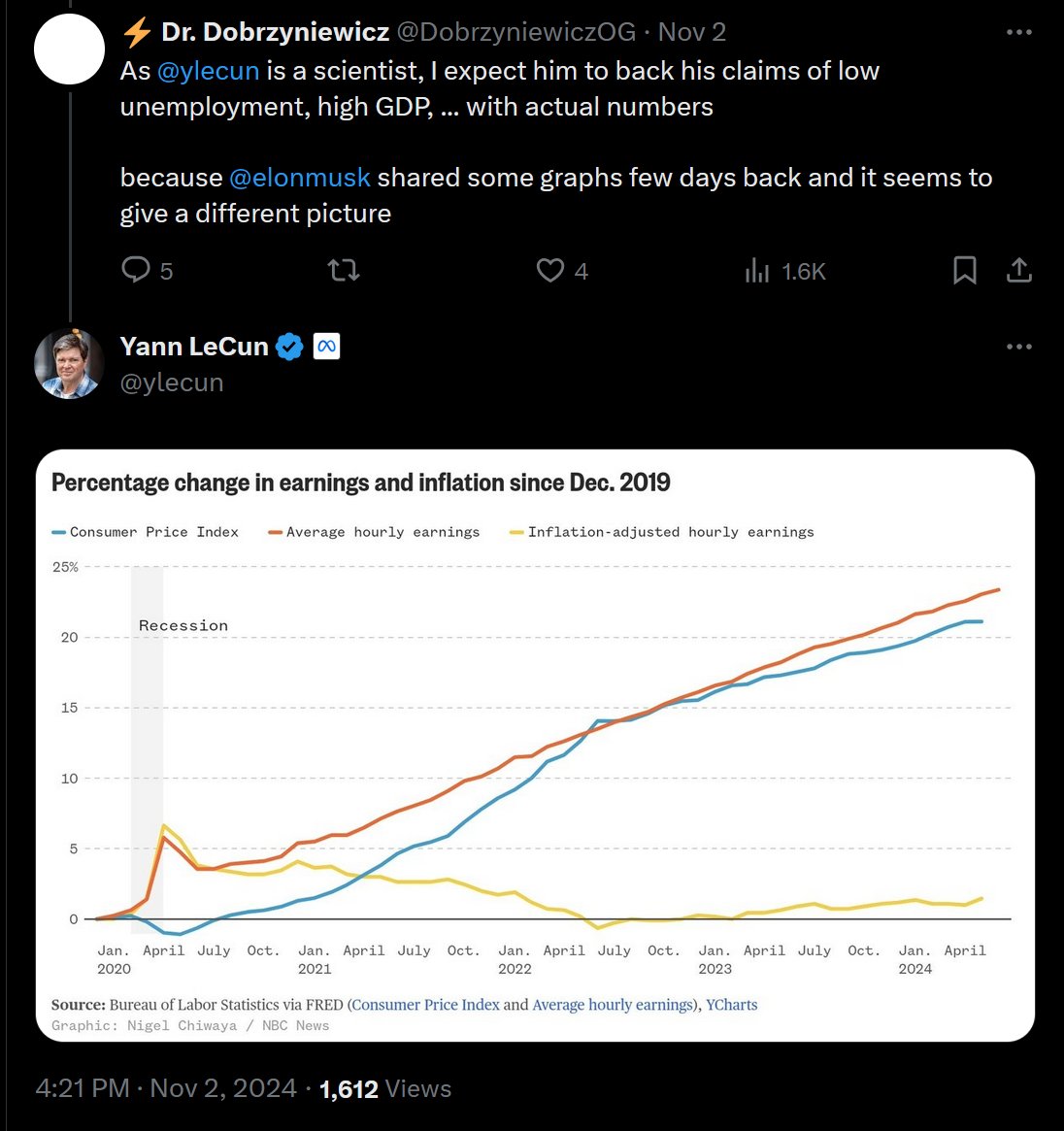
When discussing economic indicators, he once again makes the mistake of treating metrics as facts.
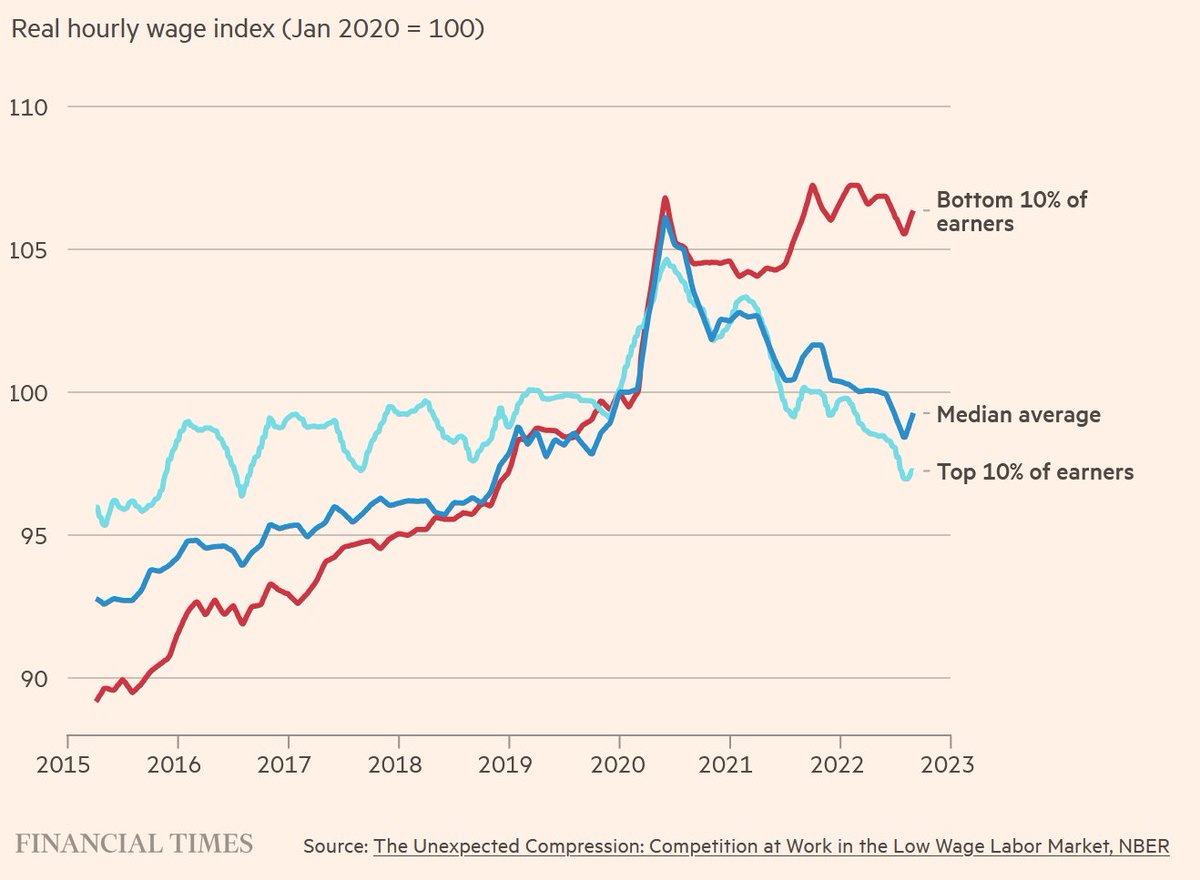
In the chart he cites, both the CPI and average hourly earnings are averages. They can be broken down along other dimensions. For example, when you break down hourly wages by income group, you see a completely different story: the middle class has seen a decline, not a rise, and they were the main voting force in this election. Low-income groups have seen some growth, but they are extremely sensitive to inflation. For people living paycheck to paycheck, even a slight fluctuation in wages can put them in trouble.
On data, Jeff Bezos once said in an interview:
When the data and the anecdotes disagree, the anecdotes are usually right. And it doesn’t mean you just slavishly go follow the anecdotes then. It means you go examine the data. ‘Cause the data, and it’s usually not that the data is being mis-collected, it’s usually that you’re not measuring the right thing.
When data and anecdotes disagree, the anecdotes are usually right. That does not mean you should blindly follow the anecdotes; it means you should reexamine the data. The problem is usually not that the data was collected incorrectly, but that you are measuring the wrong thing.
The biggest difference between entrepreneurs like Jeff Bezos and IYIs is whether they have skin in the game. If Bezos blindly trusts certain data and metrics, his company will lose customers and be driven out of the market. All of the above is part of every data scientist’s onboarding at Amazon.
IYIs like Yann LeCun, including many economists, love treating their models and data as laws of physics. When people complain about the economy and inflation, these lofty elites pull out the “facts” they have worked out in their ivory towers to educate the “populists” who lack “scientific” literacy and can only be brainwashed by conspiracy theories. They love mocking other people’s failures, such as Trump’s past bankruptcies. They like saying, “See, I told you so.” Because they have no skin in the game, they have never failed.
People with skin in the game also make mistakes. Bezos, for example, bought The Washington Post and spent the past few years attacking Trump. But in the end, he was still able to face the problem. Someone who spends too long in an environment without skin in the game is like an animal raised by humans: they permanently lose the ability to survive in the wild. So Yann LeCun finally chose to be an ostrich and returned to his comfort zone.
Images from the original
The images below follow the order supplied with the source; their positions in the original text are unknown.

Original image 5 (external link)

This article was translated from the Chinese original posted on X.